Automated Tools for Character Arc Planning: 2026 Guide
Table of Contents
- What Are Automated Tools for Character Arc Planning?
- Why Character Arc Planning Matters for Your Story
- AI-Powered Character Development Software
- Visual Mapping Tools: Non-AI Character Arc Templates
- Character Consistency Checker Features Across Platforms
- Comparison Table: Top Automated Tools for Character Arc Planning
- Integration with Scrivener and Word: A Privacy-First Advantage
- How to Choose the Right Tool for Your Workflow
- Common Mistakes When Planning Character Arcs Automatically
- Conclusion
What Are Automated Tools for Character Arc Planning?
Automated tools for character arc planning are software platforms that help writers develop, track, and visualize how characters evolve throughout their stories. Writers juggling multiple characters often struggle to maintain consistency, plot threads diverge, character motivations shift unexpectedly, and emotional arcs flatten. These tools solve that problem by automating the tedious work of mapping character progression, emotional beats, and story turning points.
You input character details, key story moments, and thematic elements, and the software generates visual timelines, beat sheets, and consistency checks. Some platforms use AI to suggest character development options; others focus purely on visualization and manual planning. The best combine both approaches, human creativity with machine-assisted organization.
What separates modern automated tools from spreadsheets is interactivity. You can drag scenes across timelines, link character decisions to plot consequences, and instantly see whether a character's behavior in chapter 8 contradicts their established motivation in chapter 3. For writers managing series across multiple books, this consistency layer becomes invaluable. According to recent studies on narrative consistency in fiction, readers notice inconsistencies within 15 pages, and character arc breaks rank among the most jarring disruptions.
Why Character Arc Planning Matters for Your Story
Character arc planning is the structural backbone that separates publishable fiction from amateur work. A character arc is the internal journey a character takes from opening to closing: how their beliefs shift, what they learn, and who they become. Without intentional planning, characters meander and readers stop turning pages.
Consider the difference between a character who changes because the plot demands it versus one whose transformation feels earned. In the first case, readers experience manipulation. In the second, they experience catharsis. That distinction lives in the arc, the deliberate series of emotional and psychological turning points that make change believable.
Many writers approach this intuitively, hoping characters grow organically. Most end up with inconsistent behavior, motivation that shifts with plot convenience, and emotional payoffs that land flat because groundwork wasn't laid. Automated tools force intentionality. They make you answer hard questions upfront: What does your character want? What do they need? What's the gap between those two things? When does that gap close, and what does it cost them?
The stakes are higher in series fiction. One character arc mistake in Book One ripples through Books Two and beyond. Series memory technology, like what ShakespeareAI offers, prevents continuity breaks by maintaining character consistency rules across multiple manuscripts.
AI-Powered Character Development Software
ShakespeareAI: Series Memory and Narrative Consistency
ShakespeareAI stands apart because it doesn't treat each book as an isolated project. The platform's series memory technology maintains character voice, emotional patterns, and narrative consistency across multiple manuscripts. You train the AI on your existing work, previous books, character sheets, and voice samples, and it learns your specific style, genre conventions, and character archetypes.
When planning character arcs for Book Two, ShakespeareAI references Book One's established character behavior, emotional beats, and thematic elements. This prevents inconsistent characterization across series installments. The platform generates complete 40,000-80,000+ word novels rather than fragments, meaning your character arc planning extends through an entire manuscript.
The built-in AI Humanizer ensures your generated prose passes detection tools. Genre-specific pacing rules keep your character's emotional journey aligned with reader expectations for your category, romance readers expect different arc timing than thriller readers, and ShakespeareAI adjusts accordingly.
You maintain creative control throughout. Regenerate chapters that don't match your vision, edit scenes directly, and override any AI suggestions. The platform exports to PDF and EPUB formats ready for publishing, with professional cover art generation included.
LivingWriter: Cloud-Based Planning with AI Assistance
LivingWriter combines a word processor with integrated story planning tools, so you build your arc while writing rather than planning separately. Story Elements let you create characters, objects, and settings, then link them throughout your manuscript. AI assistance generates brainstorming suggestions and editing feedback as you write.
Pre-made templates for story structures, Hero's Journey, Three Act Structure, and others, provide arc frameworks you can adapt. Cloud-based syncing means you access your project across devices. Where LivingWriter excels is the seamless transition between planning and drafting. You outline your character arc, then immediately begin writing scenes that feed into that arc.
The platform tracks which story elements appear in which scenes, helping you identify pacing gaps or character moments you've missed. For discovery writers who prefer outlining-while-drafting, this workflow feels natural. The free tier includes basic planning features; advanced automation requires a subscription. Setup typically takes 15-20 minutes.
Character.AI: Interactive Character Voice Development
Character.AI takes a conversational approach to arc planning. Rather than filling out character sheets, you create an AI character and interact with it through chat. This forces you to articulate how your character actually talks, what they care about, and how they react under pressure, not abstractly, but in real-time conversation.
The platform excels at developing character voice and personality quirks. You workshop dialogue, test how a character responds to conflict, and discover behavioral patterns you hadn't consciously planned. The free tier gives you unlimited character creation and interaction.
The limitation is scope. Character.AI generates text-based interactions, not full story arcs or visual timelines. Use it for workshops and brainstorming, then transfer those insights to a more structured platform for actual arc mapping. Many writers use Character.AI alongside other tools.
Visual Mapping Tools: Non-AI Character Arc Templates
Plottr: Timeline and Beat Sheet Visualization
Plottr is the gold standard for writers who think visually. The timeline interface lets you drag scenes across a horizontal axis, seeing how character arcs align with plot beats. Over 40 customizable templates provide proven story structures you can adapt. Character sheets include customizable fields.
The beat sheet feature is particularly strong for arc planning. You can map emotional turning points, decision moments, and consequence scenes across your timeline. Integration with Word and Scrivener means you can export your outline without manual re-entry. Cloud sync and real-time collaboration (in Pro plans) let multiple writers work on the same project.
Plottr avoids AI features, appealing to writers who prefer manual control. The learning curve is gentle, most writers are productive within 30 minutes. Starting at $15/month or a one-time lifetime purchase, Plottr is cost-effective for serious writers.
Campfire: Modular Character and Arc Tracking
Campfire's modular approach means you pay only for the features you need. The Characters module handles detailed character profiles. The Arcs module specifically tracks character evolution throughout your story. The Relationships module maps intricate character connections, essential for ensemble casts or complex fantasy worldbuilding.
Campfire shines for fantasy and science fiction writers managing deeply interconnected story elements. The ability to link characters to locations, objects, and plot events prevents continuity errors. The modular pricing model means costs add up if you subscribe to multiple modules, but the free tier offers generous limits.
Reedsy Studio: Free Visual Story Planning
Reedsy Studio is genuinely free for core planning features, with optional paid add-ons for advanced capabilities. The Boards feature lets you visualize your story roadmap using customizable cards for characters, locations, and narrative devices. You can define attributes and link relationships between notes.
The free tier includes cloud-based access, export to PDF and EPUB, and basic manuscript goal tracking. The interface is intuitive, most writers start planning within minutes. For writers on a tight budget or testing visual planning before investing, Reedsy Studio provides legitimate value.
| Tool | Starting Price | Best For | Free Tier | AI Features |
|---|---|---|---|---|
| ShakespeareAI | See pricing page | Series consistency & full novel generation | Yes | Advanced series memory |
| LivingWriter | $9.99/month | Drafting with integrated planning | Yes | Brainstorming & editing suggestions |
| Plottr | $15/month | Visual timeline & beat sheet planning | No | None |
| Campfire | $1/month | Fantasy/sci-fi with complex relationships | Yes | None |
| Reedsy Studio | Free | Budget-conscious writers | Yes | None |
| Character.AI | Free | Character voice development | Yes | Conversational AI |
Character Consistency Checker Features Across Platforms
Character consistency checking separates amateur planning from professional-grade arc management. This feature flags contradictions: if your character established a fear of heights in Chapter 3, the tool alerts you when they climb a mountain in Chapter 12 without addressing that fear.
ShakespeareAI's consistency checker integrates series memory, comparing character behavior across multiple books. If Character A behaved one way in Book One, the system flags any significant personality shifts in Book Two that aren't narratively justified. This prevents subtle continuity errors that readers notice but struggle to articulate.
Plottr and Campfire offer manual consistency checking through their linking systems. You establish character traits and emotional states, then visually map how those elements change across scenes. The visual nature makes inconsistencies obvious.
The most effective approach combines automated checking with manual review. Automation catches mechanical inconsistencies; human judgment catches narrative inconsistencies that are technically consistent but emotionally wrong.
Comparison Table: Top Automated Tools for Character Arc Planning
When selecting an automated tool, match your workflow to the platform's strengths. Plottr wins for visual planners who want total control. ShakespeareAI wins for series writers needing consistency across multiple manuscripts. Character.AI wins for voice development. Reedsy Studio wins for budget-conscious writers.
| Feature | ShakespeareAI | Plottr | Campfire | LivingWriter | Reedsy Studio |
|---|---|---|---|---|---|
| Visual timeline | Yes | Excellent | Good | Good | Basic |
| Character consistency checking | Across series | Manual | Manual | Basic | Manual |
| AI assistance | Series memory, generation | None | None | Brainstorming | None |
| Beat sheet templates | 15+ genres | 40+ | Customizable | Multiple | Basic |
| Free tier | Yes | No | Yes | Yes | Yes |
| Collaboration | Yes | Pro plans | Yes | Yes | Yes |
| Export formats | PDF, EPUB, Word | Multiple | Multiple | Multiple | PDF, EPUB |
Integration with Scrivener and Word: A Privacy-First Advantage
Many writers already use Scrivener or Microsoft Word as their primary writing environment. Rather than abandoning your existing workflow, the best arc planning tools integrate seamlessly with these applications. Plottr exports outlines directly to Scrivener. Reedsy Studio and LivingWriter both support Word document export.
This integration matters for privacy-conscious writers. If you're hesitant about cloud storage or AI systems accessing your manuscript, you can plan your character arcs in a cloud tool, export the outline, and write your novel entirely offline in Scrivener. Your actual manuscript never touches the cloud platform's servers.
ShakespeareAI takes a different approach, the entire writing process happens within the platform, which raises legitimate privacy concerns for some writers. However, the trade-off is that series memory consistency checking requires access to your previous manuscripts. If you're comfortable with that arrangement, the consistency benefits are substantial.
For writers using Word, most platforms support .docx export, though formatting sometimes requires cleanup. Test the export process with a small project before committing to a tool for a full novel.
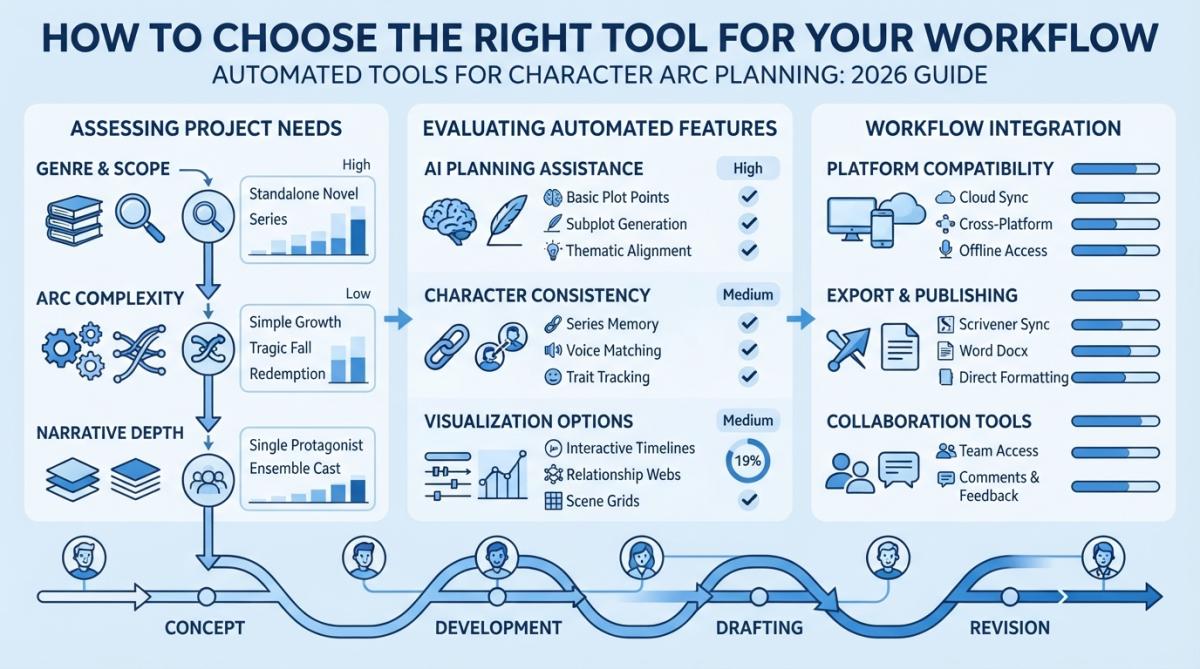
How to Choose the Right Tool for Your Workflow
Selecting the right tool requires honest assessment of how you actually write. Discovery writers who outline-while-drafting benefit from LivingWriter's integrated approach. Plotters who map everything before writing prefer Plottr's timeline visualization. Series writers need ShakespeareAI's consistency features.
Start by identifying your primary pain point. Is it character consistency across multiple books? Series memory tools like ShakespeareAI address this directly. Is it visualizing complex emotional arcs? Plottr excels here. Is it developing authentic character voice? Character.AI provides immediate feedback. Is it cost? Reedsy Studio and Campfire's free tiers are legitimate options.
Consider your existing software stack. If you're committed to Scrivener, prioritize tools with strong Scrivener integration. If you draft in Word, confirm the tool exports cleanly to .docx. Test before committing. Most platforms offer free trials or free tiers. Spend 2-3 hours planning a single character arc in your top three choices. Notice which interface feels natural and which one encourages deeper thinking.
| Selection Criteria | Best Tool | Why |
|---|---|---|
| Series consistency across multiple books | ShakespeareAI | Series memory maintains character voice and behavior across manuscripts |
| Visual timeline planning | Plottr | Drag-and-drop interface with 40+ story structure templates |
| Budget-conscious writers | Reedsy Studio | Genuinely free with optional paid add-ons |
| Character voice development | Character.AI | Conversational interaction forces authentic characterization |
| Integrated drafting + planning | LivingWriter | Write while planning without switching applications |
| Fantasy/sci-fi with complex relationships | Campfire | Relationship mapping and modular feature selection |
Common Mistakes When Planning Character Arcs Automatically
The most frequent error is over-relying on templates. A Hero's Journey structure works for certain stories and falls flat for others. Writers sometimes force their character arc into a template's shape rather than letting the character's actual journey determine the structure. Templates should inspire, not constrain.
Another mistake is planning arcs in isolation from plot. Character arcs and plot arcs are interdependent, the character changes because of what happens to them, and what happens to them depends on who they are. Planning character development without considering how plot events will trigger that development creates arcs that feel disconnected from the story.
Writers also frequently underestimate the importance of the character's emotional journey. They plan external plot points, the character loses their job, falls in love, discovers a secret, but neglect the internal response. The external events are plot; the internal response is character.
Finally, many writers plan character arcs but fail to track them during drafting. You create a beautiful arc outline, then write 50,000 words and realize you've deviated significantly. Some deviation is healthy; discovery during drafting often improves the story. But significant deviation suggests the original plan wasn't internalized. Review your arc outline weekly during drafting.
Conclusion
Character arc planning separates published authors from aspiring writers. The difference isn't talent, it's intentionality. Automated tools for character arc planning make intentionality accessible, even for writers juggling complex narratives across multiple books. Whether you prioritize visual mapping, AI assistance, or integration with your existing workflow, a tool exists that matches your needs.
For series writers managing character consistency across multiple manuscripts, ShakespeareAI offers series memory technology that maintains character voice and behavior patterns automatically. The platform generates complete novels rather than outlines, preserves your unique narrative voice through style-matching AI, and ensures emotional arcs remain consistent from Book One through subsequent installments. Get started with ShakespeareAI and ship your next book series with confidence that your characters will feel authentic and consistent throughout. [Start Writing Free →](https://shakespeareai.net)
Frequently Asked Questions
What is the difference between AI-powered and manual character arc planning tools?
AI-powered tools like ShakespeareAI and LivingWriter use machine learning to generate character suggestions, emotional journey tracking, and automated beat sheets. Manual tools like Plottr and Campfire rely on templates and visual mapping where you control every element. AI tools accelerate brainstorming and reduce planning time; manual tools offer more creative control and work offline. The best choice depends on whether you prioritize speed or hands-on character development.
Can automated character development software maintain consistency across multiple books in a series?
Yes, specifically designed platforms like ShakespeareAI use series memory technology to track character traits, motivations, and voice patterns across sequential novels. Tools like Campfire and Plottr allow you to link characters across projects and maintain detailed character sheets that sync across books. This ensures your character's arc progression, personality quirks, and relationships remain consistent from book one through the final installment, critical for reader immersion in series fiction.
Are there free automated tools for character arc planning and character arc templates?
Yes. Reedsy Studio offers completely free visual story planning with customizable character arc templates. LivingWriter, Campfire, and Character.AI all have free tiers with generous limits for character development and basic arc planning. Arc Studio Pro offers a free version for screenwriters. However, free plans typically limit the number of characters, story elements, or advanced features like real-time collaboration or unlimited cloud storage. Paid plans unlock full functionality.
How do I ensure my AI-generated character arcs pass consistency checks before publishing?
Use tools with built-in character consistency checkers, ShakespeareAI's AI Humanizer and series memory validate character behavior across chapters. Manually review generated arcs against your truth chart and beat sheet to catch contradictions. Export your character data to Scrivener or Word for line-by-line editing. Cross-reference character motivation, dialogue tone, and emotional journey against your outline. Many writers use both automated extraction and manual verification to catch inconsistencies AI might miss.