Avoiding AI Detection in Creative Writing
Table of Contents
- Why AI Detection Matters for Your Stories
- How to Humanize AI Text So It Sounds Real
- Write in Your Own Voice, Not a Robot's
- Examples of Human-Like Writing Style You Should Aim For
- Vary Your Sentence Structure and Length
- Add Personal Stories and Real Emotions
- Edit and Proofread Like a Real Author
- Understanding AI Detection Tools for Writers
- Conclusion
Why AI Detection Matters for Your Stories
When you write a novel, you want readers to feel like a real person created it. That real, human touch is what makes stories stick with people. But if your writing sounds like it came from a machine, readers notice. They might leave bad reviews, stop reading, or worse, they might think you didn't actually write your own book.
Detection tools are getting smarter every day. Platforms like Amazon KDP, literary agents, and even readers themselves use these tools to spot machine-generated content. If your book gets flagged, you could face rejection, credibility damage, or removal from platforms. For authors using writing tools to draft faster, learning how to avoid detection isn't about being sneaky, it's about maintaining the authenticity that readers demand.
This matters especially if you're using tools to speed up your writing process. The good news: avoiding detection in creative writing is completely achievable. It requires understanding how detection works and then applying specific techniques to make your prose sound like it came from a real person's hands.
How to Humanize Your Text So It Sounds Real
Machine-generated text has recognizable patterns. It tends to be too smooth, too consistent, and too predictable. Real human writing is messier. It has personality quirks, unexpected word choices, and natural variation in how sentences flow.
To make your text sound more human, start by reading it aloud. Your ear catches awkwardness that your eyes miss. If a sentence sounds robotic when you speak it, rewrite it. Real writers stumble, backtrack, and use conversational language. They don't always follow perfect grammar rules.
Break up long, flowing sentences into shorter ones. Machines love creating compound sentences that feel elegant but impersonal. Humans write in chunks, short bursts followed by longer explanations. Mix your sentence lengths deliberately. A three-word sentence followed by a twenty-word one creates rhythm that feels alive.
Add specific details that only a human would include. Machines tend toward generalities. Instead of "The character felt sad," describe exactly how sadness showed up: "Her fingers went cold. She stared at the same paragraph for five minutes without reading a word." Specific sensory details are your best tool for avoiding detection.
Use contractions naturally. "It is" sounds formal and distant. "It's" sounds like how people actually talk. Sprinkle contractions throughout dialogue and narration. Real writers use them constantly.
Insert occasional imperfect word choices that feel authentic. Not mistakes, just the kind of word selection a tired writer at 2 AM might make. Instead of always choosing the perfect synonym, sometimes pick the slightly less elegant option that feels more human.
Write in Your Own Voice, Not a Generic One
Your voice is what separates your books from everyone else's. It's your fingerprint as a writer. If you use tools to draft but then edit everything through a generic filter, you lose that voice. Detection tools actually look for voice, or the absence of it.
Start by identifying what makes your writing style unique. Do you use short, punchy sentences? Do you love metaphors? Do you write in a conversational tone, like you're talking to a friend? Whatever your natural style is, protect it fiercely.
When you work with drafted text, edit it to sound like you. If the draft creates a paragraph that's too formal for your voice, rewrite it in your natural tone. If it uses words you'd never use, swap them out. This isn't about perfecting the draft, it's about making sure the final manuscript sounds like it came from your brain.
Read your favorite authors in your genre. Notice how they structure sentences, choose words, and build paragraphs. You're not copying them, you're training your ear to recognize strong voice. Then apply those lessons to your own work.

One practical approach: write a short scene entirely by hand before using any tools. Get a feel for your natural rhythm. Then, when you work with drafted text, edit it back toward that natural rhythm. Your voice becomes the filter through which all content passes. If you want extra help making sure your writing sounds authentically like you, Try ShakespeareAI Free to see how it can assist with your editing process.
Examples of Human-Like Writing Style You Should Aim For
Human-like writing has certain characteristics that make it feel real. Understanding these helps you recognize when text needs deeper editing.
Real writing uses active voice most of the time, but not always. "The door slammed shut" is active and strong. But sometimes humans write passively: "The door was slammed by the wind." Mixing these creates natural variation that detection tools don't expect.
Real writers use specific names, places, and details. Instead of "the main character went to a coffee shop," a human writer might write: "Sarah pushed through the door at Rosie's Café on Fifth Street, the one with the broken espresso machine." Specificity is human. Generality is robotic.
Look at how real writers use punctuation. They use em dashes, like this, to add emphasis or create pauses. They use ellipses sometimes… to show trailing thoughts. They use exclamation points sparingly! Real dialogue has interruptions, stutters, and incomplete sentences. "I think we should, " "No, you don't understand." That's how people actually talk.
Real writers repeat words sometimes. Not constantly, but naturally. "The house was cold. Cold enough that Sarah could see her breath." A detection tool might flag this as repetitive, but a human reader feels the emphasis. Machines avoid repetition obsessively.
Real writing has emotional texture. It's not just plot and description, it's feeling. "The letter arrived on Tuesday" is fine. "The letter arrived on Tuesday, and my stomach dropped" has human emotion woven in. Detection tools look for emotional consistency and authentic reactions.
Here's what to avoid: overly complex vocabulary used incorrectly. If your character is a plumber, they shouldn't suddenly use medical terminology. Real writers stay in character. Real dialogue sounds like the person speaking, not like a thesaurus.
Vary Your Sentence Structure and Length
This is one of the easiest ways to avoid detection. Machines tend to create sentences that follow similar patterns and lengths. Humans naturally vary how they write sentences.
Short sentences hit hard.
They create emphasis. Longer sentences, on the other hand, allow you to weave together multiple ideas and create a flowing, connected narrative that builds momentum and complexity. See the difference? The variation makes writing feel alive.
Try this exercise: take a paragraph of drafted text and deliberately rewrite every other sentence to be much shorter or much longer. If the draft created: "The character walked into the room and noticed the window was open, which surprised her because she remembered closing it before she left." Rewrite it as: "The character walked into the room. The window was open. She'd closed it before leaving. Something was wrong."
Real writers use fragments. "Not a complete sentence. Just a thought." Detection tools flag this as an error, but humans do it all the time in creative writing. It creates voice and rhythm.
Vary your paragraph length too. Some paragraphs should be one sentence. Others should be five or six. Some should be one word: "Silence." Real writing has white space. It has breathing room. Machines tend to create uniform paragraph lengths.
Pay attention to how you start sentences. Real writers begin sentences with different words and structures. "She walked to the window. Looking out, she saw nothing. The street was empty." Notice how each sentence starts differently? Machines tend to repeat patterns: "She walked to the window. She looked out. She saw nothing." Changing your sentence openers is a simple edit that makes huge difference.
Add Personal Stories and Real Emotions
Detection tools struggle with genuine human emotion because it's unpredictable. Real people don't feel emotions in logical, consistent patterns. They contradict themselves. They feel conflicted. They react in ways that don't always make perfect sense.
If you're writing fiction, inject authentic emotional truth into your characters. Don't just tell the reader a character is sad. Show the specific physical sensations of sadness: the heaviness in the chest, the way tears blur vision, the strange numbness that comes after crying stops.
Real writers draw from lived experience. You've felt heartbreak, joy, anger, confusion. Channel those genuine emotions into your characters. A reader can sense when emotion is authentic versus manufactured.
Personal anecdotes, even in fiction, ground a story in reality. If you're writing a scene where a character loses a job, think about a time you felt rejected or humiliated. What details do you remember? The smell of the office? The exact words someone said? The way your hands shook? Those specific, sensory memories make writing feel real.
Real emotions are messy. A character might feel grateful and resentful at the same time. They might cry from anger, not sadness. They might laugh inappropriately when nervous. These contradictions are human. They're also signals to detection tools that real thinking is happening.
Write scenes that matter to you personally, even if the surface story is completely fictional. If you care about what you're writing, that emotional investment shows through. Readers feel it. Detection tools notice when emotion is genuine versus generic.
Edit and Proofread Like a Real Author
Editing is where you transform drafted work into genuinely human-sounding prose. But editing serves another purpose too: it protects you from false accusations. Sometimes real human writing gets flagged as computer-written, especially if you write in a clear, consistent style. Understanding how to edit protects you on both fronts.
The editing workflow:
Start with a full read-through without making changes. Just read it like a reader would. Where does it feel robotic? Where does it lose you? Mark those spots. Those are your problem areas.
Then edit for voice. Go through and ask: would I write this sentence this way? If the answer is no, rewrite it in your natural voice. This isn't about correcting grammar, it's about making sure every sentence sounds like it came from you.
Look for detection red flags: overly consistent paragraph structure, sentences that are all similar lengths, vocabulary that feels too formal or too uniform, emotional beats that feel mechanical. Fix these by introducing variation and personality.
Read dialogue aloud. Does it sound like how people actually talk? Real dialogue has contractions, interruptions, filler words, and incomplete sentences. "I was thinking, you know, that maybe we should..." sounds real. "I was considering the possibility that perhaps we should proceed" sounds like a machine.
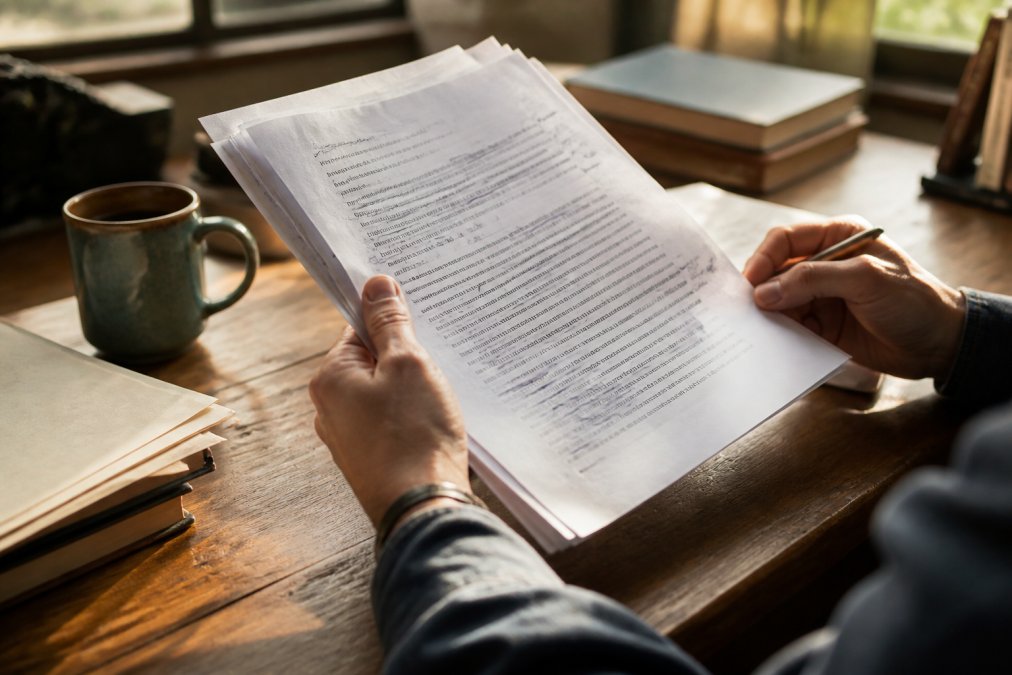
Check for repetitive word patterns. If you use the same word three times in a paragraph, change at least one instance. But if you repeat a word for emphasis, keep it. "The house was cold. Cold and empty." That's intentional. Machines avoid this; humans use it for effect.
Look for places where you can add specific details. Generic descriptions are robotic. Specific ones are human. "She was angry" becomes "Her jaw clenched. She couldn't look at him." Details matter.
Protecting yourself from false positives:
Here's something most people don't talk about: sometimes real human writing gets flagged as computer-written. This happens when your writing is too clean, too consistent, or too polished. Professional writers and academics face this risk constantly.
If you write in a very organized way, clear topic sentences, logical flow, minimal errors, detection tools might flag you unfairly. You can protect yourself by deliberately adding the kind of imperfections that signal human authorship. Not mistakes, but authentic choices: a sentence fragment for emphasis, a repeated word for effect, a slightly awkward phrasing that feels more conversational.
Add margin notes or comments to your manuscript that show your thinking process. "I rewrote this three times" or "This felt too formal, made it more personal" shows human deliberation. If you ever need to defend your work, these notes prove you edited intentionally.
Keep a version history if you're working digitally. Show the progression from draft to final. Real writers revise constantly. That visible revision history is proof of human authorship.
If you're writing in a formal genre (academic papers, business reports, legal documents), you can add a brief author's note explaining your process. "This manuscript was drafted with writing assistance for speed, then extensively edited and revised to reflect my voice and expertise." Transparency actually builds credibility.
Finally, proofread for typos and grammar, but leave some personality quirks in place. Real writers have stylistic choices that aren't technically correct. If your style uses dashes frequently or sentence fragments for effect, keep those. They're part of your voice and proof of your authorship.
Understanding Detection Tools for Writers
Knowing how detection tools work helps you understand what to avoid. These tools don't look for specific words or phrases. They analyze deeper patterns in your writing, kind of like how you can recognize your friend's handwriting even if you can't see their name.
Detection tools look at how predictable your writing is. When a machine writes something, it tends to follow the same patterns over and over. It picks similar sentence lengths. It uses words in similar ways. It builds ideas in a predictable order. Real human writers are messier. You write a short sentence, then a long one. You pick an unusual word sometimes. You circle back to an idea you mentioned earlier. That unpredictability is actually your strength.
They also check how much your sentences change. Do you write long sentences, then short sentences, then medium ones? Or do all your sentences feel about the same length? Machines tend to make sentences that all feel similar. Humans naturally switch it up. Short. Then longer. Then short again. That switching back and forth is a sign of real human writing.
Detection tools measure whether your ideas make sense together. But here's something interesting: humans don't always flow perfectly logically. You might start explaining something, then realize you need to back up and explain something else first. You might add a side thought in the middle. You might repeat yourself for emphasis. That's normal human thinking. Machines create perfectly straight-line logic, like following a recipe exactly.
These tools also look at how many different words you use and how you use them. A machine might use the same fancy word over and over, or switch between fancy words and simple words in a weird way. Real writers naturally shift between simple and complex words depending on what they're talking about. You might use technical words in one sentence and simple words in the next. That shift is human.
Most importantly, detection tools have been trained on millions of examples of machine-written content, so they recognize the patterns machines make. The more you edit your writing to sound like you, with your own voice, your own rhythm, your own way of explaining things, the more invisible any assistance becomes.
The good news: every edit you make toward your authentic voice moves you away from patterns that detection tools recognize. You're not fighting the tools, you're just being a real writer.
Conclusion
Avoiding detection in creative writing isn't about hiding your process. It's about making sure your final manuscript sounds like it came from a real human being who has thoughts, emotions, quirks, and a unique voice.
The techniques work together: varying sentence structure, adding specific details, using authentic emotion, writing in your voice, and thorough editing. None of these are new. They're just good writing practices.
If you're using tools to draft faster, remember that the drafted text is just your starting point. Real authorship happens in the editing. That's where you inject personality, voice, and the beautiful imperfection that makes writing feel alive. Tools like ShakespeareAI Book Writer can help you create and refine your work, but the final voice is always yours.
The authors who succeed with writing assistance are the ones who treat the draft as a rough sketch, not a finished painting. They edit heavily. They rewrite for voice. They add their own experiences and emotions. They vary their sentences deliberately. They proofread like professionals.
That's how you create work that passes detection tools, impresses readers, and feels genuinely human. Because it is human, it's you, expressed through your unique voice, with all the beautiful inconsistency that real writing requires.
Frequently Asked Questions
What makes writing sound like it was created by AI instead of a human?
AI writing often follows predictable patterns: sentences that are all the same length, vocabulary that feels generic, and ideas arranged too perfectly. Real human writing is messier. People use short sentences next to long ones, repeat words sometimes, and jump between ideas in ways that feel natural. Detection tools spot these patterns by measuring something called perplexity (how surprising each word choice is) and burstiness (how your sentence structure changes). When everything is too uniform, it looks like AI.
How can I use AI tools to write but still avoid AI detection?
Use AI as a starting point, not your final answer. Write your first draft with AI, then edit it heavily. Add your own experiences, change sentence lengths around, remove overly polished phrases, and inject your personality. Read it out loud, if it sounds stiff, rewrite it. Tools like ShakespeareAI include built-in humanization features that help you adjust the output to sound more like you wrote it, making it harder for detection tools to flag your work as machine-generated.
Can AI detection tools make mistakes and flag human writing as AI?
Yes, false positives happen. If you write very formally or use simple, repetitive sentence structures, detection tools might incorrectly flag your work as AI. This is why manually editing your work matters so much. Adding variety to your writing, different sentence lengths, casual phrases, and personal touches, protects you from both real AI detection and false accusations. The goal is to write in a way that's unmistakably human.
What's the difference between avoiding AI detection and writing ethically?
Avoiding detection means making AI-assisted writing sound human so readers can't tell. Writing ethically means being honest about how you created your work if it matters to your audience. For creative fiction, readers care about the story, not whether you used AI tools to draft it. But for academic work, journalism, or content where authenticity is promised, hiding AI use crosses an ethical line. Know your context and your audience's expectations before deciding how transparent to be.
Ready to write with authenticity and speed? Start writing free with ShakespeareAI and see how the platform's humanizer technology helps you create prose that sounds unmistakably human. Try ShakespeareAI Free and discover how real authors are combining AI assistance with authentic voice to publish faster.