Choose ShakespeareAI for an outline-led book draft, Sudowrite for hands-on fiction drafting and revision, or Squibler for a planning-and-writing workspace. Compare the recurring price, revision allowance and export workflow using the same chapter brief. The best fit is the tool that reduces your editing work without removing the control you need.
This guide does not rely on unverifiable private testing or invented output scores. Instead, it shows you how to give each tool the same one-page brief and compare planning, control, continuity, revision effort, and export fit. If you are still deciding whether AI belongs in your process, read is AI writing worth it? first.
AI Book Writing Starter Kit
A writing checklist and title templates to help plan your next manuscript.
No spam. Unsubscribe anytime.
Use the same one-page creative brief in each tool. Score setup clarity, outline usefulness, author control, continuity, revision effort, and export fit from one to five. This page is published by ShakespeareAI, so run the test yourself and verify competitor features on their official sites.
The Three Workflows at a Glance
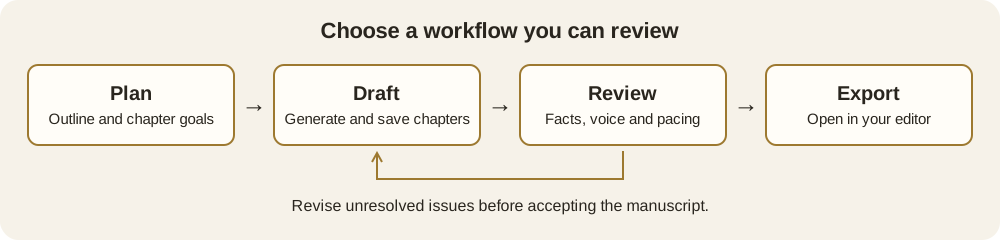
ShakespeareAI — A book-first workflow for moving from premise and structure toward a connected long-form draft.
Sudowrite — An interactive fiction-writing workflow for brainstorming, developing, and revising prose inside an editor.
Squibler — A broader writing workspace that combines project organization with planning and drafting assistance.
Do not choose from a monthly price headline alone. Compare current limits with the number of chapters, revisions, and exports your project actually requires.
Comparison 1: Onboarding and Setup
ShakespeareAI
Start with the premise and book structure. Test whether you can define genre, audience, length, character facts, and chapter goals clearly before generating prose.
Best-fit test: Can you get from a detailed premise to an outline you would actually revise?
Sudowrite
Approach the product as an interactive fiction editor. Test how naturally you can move between story planning, brainstorming, scene drafting, and revision without losing your creative intent.
Best-fit test: Does frequent scene-level direction feel useful or interrupt your momentum?
Squibler
Build a small real project rather than relying on a feature tour. Add notes, an outline, two chapters, and a revision so you can judge how well the workspace handles an accumulating manuscript.
Best-fit test: Does keeping planning and drafting together reduce tool switching for you?
Decision rule Choose the setup that makes your next meaningful writing step obvious.
Comparison 2: Outline Quality
ShakespeareAI
Check whether the book-first outline gives every chapter a distinct purpose, a causal connection to the next chapter, and enough detail to prevent generic drafting.
Sudowrite
Check whether interactive brainstorming helps you develop specific beats while leaving you in control of which ideas become part of the story.
Squibler
Check whether the outline remains easy to navigate alongside notes and drafts, and whether a structural change updates the project cleanly.
Decision rule Reject any outline with repeated beats, vague chapter goals, missing causality, or subplots that disappear.
Comparison 3: Prose Quality
Use the same opening-scene brief in every product, then compare specificity, rhythm, point of view, repeated phrasing, and adherence to your voice sample. The passages below are illustrative editing examples written for this guide; they are not represented as outputs from the named products.
Illustrative draft A: conversational pacing
The candle had burned down to a stub by the time Mira noticed the discrepancy. She'd been inking the coastline of Pellworth for three hours, cross-referencing her field sketches with the council's survey records, and her eyes were doing that thing where the lines started swimming if she looked too long.
But this wasn't her eyes.
The harbor was wrong. Not wrong like she'd made a mistake — she didn't make mistakes, not with maps, not anymore — but wrong like someone had moved the buildings.
Mira set down her pen. Picked it back up. Set it down again.
"That's new," she said to no one.
Analysis: Conversational, good pacing, decent character voice. The "set down her pen, picked it back up" beat feels human.
Illustrative draft B: literary compression
The map was lying.
Mira knew this the way a carpenter knows when wood is warped — not through measurement, but through the wrongness of it against her fingertips. She had surveyed Pellworth herself, walked its streets with her brass compass and her leather case of instruments, recorded every alley and archway with the precision that had made her the youngest licensed cartographer in the Guild's history.
Pellworth had a fishmarket on Anchor Street. She had sketched it on Tuesday. But the map beneath her hands showed only emptiness where the fishmarket should be.
Not a blank space. Not an error. Emptiness, the kind that felt intentional.
Analysis: More polished, more literary. The carpenter metaphor is elegant. This reads like a published fantasy novel.
Illustrative draft C: summary-like prose
Mira was working late in her workshop when she noticed something strange about the map she was drawing. The coastal town of Pellworth, which she had carefully surveyed just last week, looked different on the parchment. Some buildings seemed to be missing from the harbor area.
She leaned closer to the map, squinting in the candlelight. The fishmarket on Anchor Street — she was sure it had been there when she visited. But on the map, that area was blank.
Analysis: Flat. Reads like a summary rather than a chapter. No voice, no personality, no rhythm.
Decision rule Prefer the workflow that helps you reproduce your intended voice consistently, not the one that produces one impressive paragraph.
Comparison 4: Long-Form Workflow
ShakespeareAI
Test the full-book path by approving an outline, generating representative chapters from the beginning and middle, and checking whether important character and plot facts remain available throughout the project.
Sudowrite
Test the editor-led path by developing scenes in sequence and measuring how much context you must restate. Decide whether reviewing each section before the next is generated improves control enough to justify the extra interaction.
Squibler
Test the workspace path by building enough of the project to expose navigation, continuity, versioning, and export friction. Confirm how notes and outline changes affect later drafting.
Decision rule Choose for the amount of author interaction you want: broad draft momentum, scene-by-scene control, or centralized project organization.
Comparison 5: Editing Required
| Editing check | What to measure | Failure signal |
|---|---|---|
| Structure | Chapter purpose, causality, pacing, and missing steps | Scenes can be reordered without changing the story |
| Continuity | Names, traits, timeline, setting, and unresolved threads | Facts drift after several chapters |
| Voice | Point of view, diction, rhythm, and emotional distance | Every character sounds alike |
| Accuracy | Claims, dates, sources, quotations, and specialist details | Plausible statements lack support |
| Line quality | Repetition, filler, cliches, and awkward transitions | Cleanup overwhelms the value of the draft |
Decision rule Edit equal-length samples and track real revision time; do not estimate publishability from raw word count.
Comparison 6: Project Cost
Plans checked September 28, 2026. Sudowrite's official pricing page describes credit-based plans and a monthly/annual billing choice. Squibler's pricing page lists Plus at US$29.99 per month billed annually with 10,000 monthly AI credits, and PDF/DOCX export. Check the amount charged today as well as the displayed monthly equivalent.
ShakespeareAI's subscription page shows current plan limits and any eligible first-month offer alongside its renewal price. Paid plans include clean PDF, DOCX and EPUB exports. Test a sample export before choosing a subscription for a whole manuscript.
| Cost input | Question to answer |
|---|---|
| Generation limits | Will the current plan cover your target length and likely retries? |
| Revision limits | Are rewrites, brainstorming, or credits metered separately? |
| Project duration | How many billing cycles will drafting and revision require? |
| Export and handoff | Will cleanup or another paid tool be required after export? |
Pricing and plan limits change. Check each provider's official pricing page on the day you decide.
Decision rule Compare the estimated cost of a finished, editable manuscript—not the cheapest advertised monthly entry point.
Comparison 7: Workflow Fit
| Workflow question | ShakespeareAI | Sudowrite | Squibler |
|---|---|---|---|
| What is the starting unit? | The book premise and structure | The story, scene, or passage | The writing project and workspace |
| Where does the author spend time? | Defining, reviewing, and revising the long-form draft | Directing and revising prose interactively | Organizing, planning, and drafting in one environment |
| What should you test first? | Outline control and cross-chapter continuity | Voice control and scene revision | Project navigation and export handoff |
| Primary risk to watch | Accepting a broad draft without enough revision | Spending too much time iterating locally | Choosing breadth before testing depth |
Which Tool Should You Evaluate First?
Choose ShakespeareAI if:
- Your premise is developed but completing a connected draft is the bottleneck
- You want a workflow designed around a full book rather than isolated copy
- You plan to revise the result as a manuscript, not publish raw output
- You want to begin with book architecture for fiction or structured nonfiction
Choose Sudowrite if:
- You write fiction and want to direct scenes closely
- Brainstorming, sensory detail, and prose alternatives are recurring bottlenecks
- You prefer frequent author decisions over a broad first-draft workflow
Choose Squibler if:
- You want planning, drafting, and organization in one workspace
- Templates and a visible project structure help you maintain momentum
- You are comparing general writing workspaces as well as AI generation
If two tools solve different stages well, test the handoff before adopting both. Export cleanup and lost project context can erase the benefit of a multi-tool setup.
Test a Book-First Workflow
Bring one clear premise and evaluate the outline, chapter control, continuity, and export against your project needs.
Compare ShakespeareAI paid plans →Want a broader shortlist? See Sudowrite alternatives for fiction writers for a practical switching test and separate AI-usage budgeting.
Frequently Asked Questions
How should I compare ShakespeareAI, Sudowrite, and Squibler?
Give each product the same project brief and score planning, scene drafting, long-form generation, revision, continuity, and export. Verify current features and plan limits on each provider's website before subscribing.
Which tool is best for generating a complete book draft?
ShakespeareAI is designed around moving from a book idea to a structured long-form draft. If you prefer to direct and revise one scene at a time, an editor-led workflow may fit better.
Which tool gives fiction writers the most scene-level control?
Sudowrite is oriented toward interactive fiction development. Test it with one representative chapter to see whether frequent prose-level direction matches your writing style.
Can I switch between tools?
Potentially, but test the handoff. Confirm current export formats, open a sample in your preferred editor, and inspect headings, paragraph breaks, notes, and special characters before moving a full manuscript.
Which tool produces the most publishable output?
No tool makes raw output publishable by itself. A manuscript still needs structural editing, continuity checks, fact checking where relevant, line editing, proofreading, and a review of rights and platform requirements. Use the AI-generated novel editing checklist, then review the KDP disclosure checklist if you plan to publish on Amazon.
Last updated September 28, 2026. ShakespeareAI publishes this comparison and therefore has an interest in the outcome; the methodology above is provided so readers can run their own same-brief test.